
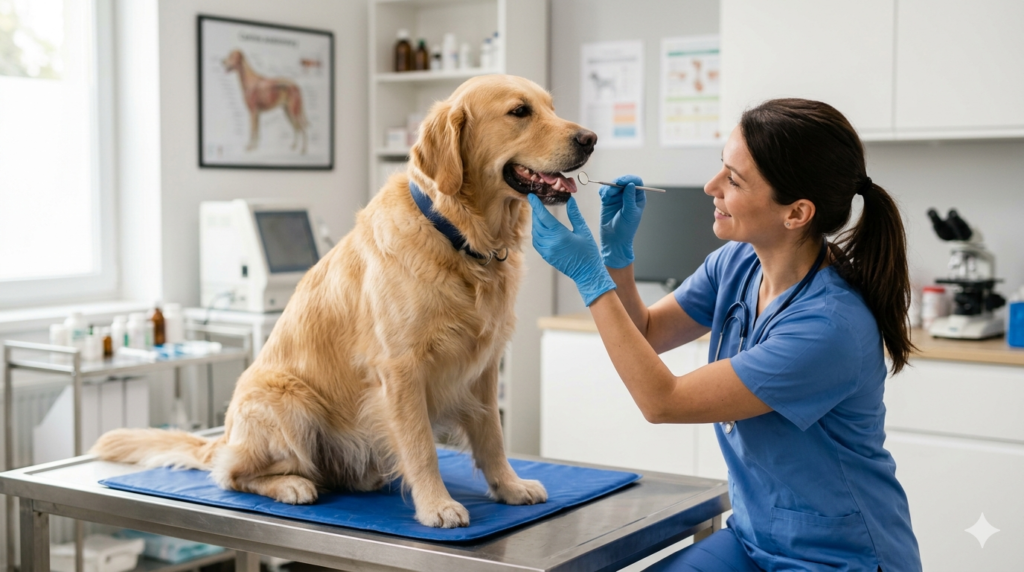

If you have ever caught a whiff of your dog’s breath and thought, “that cannot be normal,” you are probably right. Bad breath in pets is not just unpleasant. It is one of the earliest and most overlooked warning signs of dental disease — a condition that affects the vast majority of dogs and cats before they reach the age of three.
At O’Connor Veterinary Clinic, we see it all the time. A pet comes in for a routine visit, and during the oral exam, we discover tartar buildup, inflamed gums, or loose teeth that have been silently causing pain for months. The owner had no idea. And honestly, that is not their fault. Pets are remarkably good at hiding discomfort.
This guide breaks down everything Toronto pet owners need to know about pet dental care — from the warning signs you might be missing at home, to what actually happens during a professional dog dental cleaning in Toronto, to the real health consequences of letting dental disease go untreated. If you have been putting off your pet’s dental health, this is your sign to stop waiting.
The Scope of the Problem: How Common Is Pet Dental Disease?
Veterinary research consistently shows that periodontal disease is the single most diagnosed condition in companion animals. By age three, a significant majority of dogs and cats already show some degree of dental disease. That includes everything from mild gingivitis — the earliest and most reversible stage — to advanced periodontitis where the bone supporting the teeth has already started to deteriorate.
What makes this so tricky is that Stage 1 gingivitis rarely causes visible symptoms. Your dog still eats. Your cat still grooms. There is no limping, no obvious distress. The damage is happening beneath the gumline, in places you cannot see without the right equipment and training.
Toronto pet owners face an additional challenge. With busy schedules and competing priorities, dental care often falls to the bottom of the wellness checklist. Vaccinations, flea treatments, and annual checkups take priority — and for good reason. But animal dental care should not be treated as optional. It is a core part of preventive health, right alongside parasite prevention for dogs and cats and routine bloodwork.
Warning Signs You Might Be Missing
One of the most frustrating things about pet oral health is that animals rarely show pain the way humans do. A dog with a fractured molar will still eat kibble. A cat with severe gum inflammation will still purr on your lap. They adapt, and they hide it.
That said, there are signals — subtle ones — that point toward dental trouble. Here is what to watch for.
Changes in eating behavior. If your dog suddenly starts chewing on one side of the mouth, drops food more often, or seems hesitant around hard treats, that is a red flag. Cats may stop crunching dry food entirely and only eat wet food, or they may eat less overall and lose weight gradually.
Bad breath that persists. A slightly “doggy” smell after a meal is one thing. Persistent, sour, or metallic breath is something else entirely. That smell typically comes from bacterial infection in the gums or from decaying tooth material — both of which require veterinary attention.
Visible tartar and red gums. Lift your pet’s lip. If you see a yellow-brown crust along the gumline, or if the gums look swollen and red instead of a healthy pink, dental disease has likely already taken hold.
Pawing at the face or rubbing the muzzle. Some pets, especially cats, will paw at their mouth when they are in oral pain. Dogs may rub their face along furniture or the carpet. It is easy to dismiss as a quirky habit, but it often indicates discomfort.
Drooling or bleeding. Excessive saliva, especially if it is tinged pink, can signal advanced gum disease, oral ulcers, or even a fractured tooth with exposed pulp.
If any of these sound familiar, your pet needs a professional dental exam sooner rather than later.
Dog Dental Cleaning in Toronto: What Actually Happens
Let us clear up a common misconception. A professional dental cleaning for your dog or cat is not the same as a human dental appointment. It is a medical procedure that requires general anesthesia, and for good reason.
Pets will not sit still with their mouth open while someone scales below the gumline with sharp instruments. Anesthesia keeps your pet pain-free, motionless, and safe while the veterinary team does thorough work — including areas that would be impossible to reach on an awake animal.
Here is the step-by-step process that typically takes place at a veterinary dental clinic near me during a professional cleaning:
Pre-anesthetic assessment. Before anything else, the veterinarian evaluates your pet’s overall health. This includes a physical exam and pre-surgical bloodwork to confirm that the kidneys, liver, and other organs can handle anesthesia safely. Senior pets or those with existing health conditions may need additional screening.
Anesthesia and monitoring. Your pet is placed under general anesthesia and monitored throughout the procedure. Heart rate, blood pressure, oxygen saturation, and body temperature are tracked continuously. A trained veterinary technician stays with your pet the entire time.
Full oral examination. Once your pet is under, the veterinarian performs a complete oral assessment. Every tooth is checked individually for mobility, fractures, pockets, and resorption. This is also when the team uses in-house medical imaging to capture dental radiographs — digital X-rays that reveal problems hidden beneath the gumline, like root abscesses, bone loss, or unerupted teeth.
Scaling and polishing. Ultrasonic scalers remove tartar above and below the gumline. This is the part that cannot be replicated at home or with anesthesia-free dental services. Subgingival cleaning — the work done beneath the gums — is where the real disease lives, and it requires proper tools and a still patient. After scaling, teeth are polished to smooth microscopic scratches left by the scaler, which reduces future plaque adhesion.
Extractions (if necessary). If the exam or X-rays reveal teeth that are severely diseased, fractured, or non-viable, the veterinarian may recommend extraction. Leaving a dead or infected tooth in place does more harm than removing it. Most pets recover quickly and eat comfortably within a few days.
Recovery and discharge. Your pet wakes up in a warm, monitored recovery area. The veterinary team provides detailed aftercare instructions, including diet modifications, pain management, and follow-up recommendations.
Cat Dental Care: A Different Animal (Literally)
While dogs tend to accumulate tartar and develop classic periodontal disease, cats have their own set of dental challenges that many owners are completely unaware of.
Feline odontoclastic resorptive lesions — often just called tooth resorption — are one of the most common dental conditions in cats. These are painful erosions that develop on the tooth surface, often at or below the gumline. Unlike cavities in humans, resorptive lesions are not caused by sugar or bacteria. The exact cause is still debated in veterinary medicine, but the result is the same: significant pain and eventual tooth loss if left untreated.
Cat dental care also comes with a behavioral layer. Cats are masters at hiding illness. A cat with a painful mouth may simply eat less, become quieter, or stop grooming — changes that are easy to attribute to aging or mood rather than a dental problem. Regular veterinary dental exams are the only reliable way to catch these issues early.
For cat owners in Toronto, this is especially important. Indoor cats, which make up a large portion of the feline population in East York and the surrounding neighborhoods, do not have the natural tooth-cleaning benefits that come from chewing on raw prey. Their diet of processed wet and dry food means plaque builds up steadily unless addressed through professional cleanings and at-home care.
Why Pet Dental Disease Is Not Just a Mouth Problem
Here is the part that surprises most owners. Dental disease does not stay in the mouth.
When bacteria from infected gums enter the bloodstream — a process called bacteremia — they can travel to and colonize major organs. Research has linked chronic periodontal disease in pets to secondary conditions affecting the heart, kidneys, and liver.
The connection between oral bacteria and heart disease in dogs, for example, has been documented in multiple veterinary studies. Bacterial endocarditis, an infection of the heart valves, has been associated with untreated dental infections. The kidneys and liver are also vulnerable because they filter blood continuously and can be damaged by sustained bacterial exposure.
This is why veterinarians view pet oral health as a systemic concern, not a cosmetic one. A professional dental cleaning is not about making your dog’s smile look nice for photos. It is about removing a chronic source of infection and inflammation that can quietly erode your pet’s overall health over the course of years.
For pet owners interested in a broader approach to wellness that considers these systemic connections, holistic veterinary medicine integrates dental care into a whole-body treatment philosophy.
At-Home Dental Care: What Works and What Does Not
Professional cleanings are essential, but they are not the whole picture. What happens between veterinary visits matters, too.
Brushing your pet’s teeth remains the gold standard for at-home dental care. Daily brushing with a pet-specific enzymatic toothpaste removes plaque before it mineralizes into tartar. The key word there is “daily.” Brushing once a week is significantly less effective because plaque begins to harden within 24 to 48 hours.
If brushing is not realistic for your pet — and for many cats, it simply is not — there are alternatives that help. Dental chews approved by the Veterinary Oral Health Council (VOHC) are backed by evidence and can reduce plaque accumulation. Water additives and dental diets also offer some benefit, though they work best as part of a layered approach rather than a standalone solution.
What does not work? Bones, antlers, and hard nylon chews. Despite their popularity, these items are responsible for a large number of tooth fractures that veterinarians treat every year. A good rule of thumb: if you cannot make an indent in it with your fingernail, it is too hard for your dog’s teeth.
Anesthesia-Free Dental Cleanings: The Uncomfortable Truth
You may have seen anesthesia-free dental services advertised at pet stores or grooming salons in Toronto. The appeal is understandable — it sounds less invasive, less risky, and less expensive.
But here is the reality. Anesthesia-free cleanings only address the visible surface of the teeth. They cannot clean below the gumline, which is where roughly 60 percent of each tooth’s structure sits and where the most damaging disease activity occurs. Without dental radiographs, there is no way to assess root health, bone loss, or hidden abscesses.
The Canadian Veterinary Medical Association and virtually every veterinary dental specialist organization advises against anesthesia-free dental procedures for this exact reason. They create the illusion of dental health — clean-looking crowns with disease festering underneath — and can delay owners from seeking the care their pet actually needs.
When to Seek Urgent Dental Care
Most dental issues are gradual, but some situations require immediate veterinary attention. If your pet experiences sudden facial swelling, a broken tooth with visible pulp exposure, uncontrolled bleeding from the mouth, or complete refusal to eat, these are dental emergencies.
In these cases, do not wait for a scheduled appointment. Contact an emergency vet near me right away. Dental abscesses can rupture through the skin below the eye, broken teeth with exposed nerves are acutely painful, and oral trauma from accidents or fights needs prompt assessment.
How Often Should Your Pet Get a Dental Cleaning?
There is no universal answer, because every pet’s mouth is different. Breed plays a role — small breeds like Yorkies, Dachshunds, and Chihuahuas are notorious for dental problems and often need annual cleanings. Larger breeds may go longer between procedures, though there are always exceptions.
Your veterinarian will recommend a cleaning schedule based on the condition of your pet’s mouth during their annual or semi-annual wellness exam. Some pets need yearly cleanings. Others can go two or three years between procedures. The key is consistent monitoring so that problems are caught early, before they become painful and expensive to fix.
If your pet has not had a dental exam recently, or if you have noticed any of the warning signs discussed earlier, now is a good time to book a dental appointment online and get a baseline assessment.
Pet Dental Care in Toronto: What to Look For in a Clinic
Not every veterinary clinic approaches dental care the same way. When evaluating an animal specialist near me for your pet’s dental needs, there are a few things that separate thorough dental programs from basic ones.
Look for a clinic that includes full-mouth dental radiographs as a standard part of every cleaning — not as an add-on. Digital X-rays are critical for detecting problems that are invisible to the naked eye. Make sure the clinic uses proper anesthesia protocols with dedicated monitoring, and ask about their approach to pain management both during and after the procedure.
A clinic that takes dental care seriously will also spend time educating you on at-home care, recommending appropriate products, and scheduling follow-up assessments based on your pet’s individual risk profile. This is the approach we take at O’Connor Veterinary Clinic in East York, where dental services include professional exams, ultrasonic scaling, polishing, extractions when needed, and digital dental imaging — all performed by experienced veterinary professionals.
Frequently Asked Questions About Pet Dental Care
-
How much does dog dental cleaning cost in Toronto?
The cost of a dog dental cleaning in Toronto varies depending on the pet’s size, the extent of dental disease found during the exam, and whether extractions or additional treatments are needed. Pre-anesthetic bloodwork, anesthesia, scaling, polishing, and dental radiographs are typically included. Your veterinarian will provide a detailed estimate after your pet’s initial dental assessment, so there are no surprises on procedure day. Contact your local veterinary dental clinic for current information.
-
Is anesthesia safe for pet dental cleanings?
Modern veterinary anesthesia is considered very safe when performed with proper protocols. Pre-surgical bloodwork screens for underlying organ issues, and continuous monitoring of heart rate, oxygen, blood pressure, and temperature keeps your pet stable throughout the procedure. The risk of leaving dental disease untreated — including chronic pain, infection, and organ damage from circulating bacteria — significantly outweighs the small risk associated with anesthesia in healthy animals.
-
How can I tell if my cat has dental problems?
Cats hide dental pain exceptionally well. Watch for subtle changes like decreased appetite, preference for soft food over kibble, weight loss, reduced grooming leading to a matted coat, drooling, or pawing at the mouth. Some cats become withdrawn or irritable when experiencing oral discomfort. Because these signs overlap with many other conditions, a professional veterinary dental exam with digital imaging remains the most reliable way to diagnose cat dental disease accurately.
-
How often should I brush my pet’s teeth at home?
Daily brushing is recommended for the best results in maintaining pet oral health between professional cleanings. Plaque starts hardening into tartar within 24 to 48 hours, so brushing less frequently reduces effectiveness significantly. Use a pet-specific enzymatic toothpaste — never human toothpaste, which contains ingredients toxic to animals. If daily brushing is not feasible, VOHC-approved dental chews and water additives provide supplemental support but should not replace professional dental care entirely.
-
What happens if pet dental disease goes untreated?
Untreated dental disease progresses from mild gum inflammation to severe periodontitis involving bone loss, tooth mobility, and chronic oral infection. Bacteria from diseased gums can enter the bloodstream and contribute to secondary problems in the heart, kidneys, and liver over time. Advanced cases often require multiple extractions under anesthesia, which is more invasive and costly than preventive cleanings. Early intervention through regular veterinary dental exams is always the better approach for your pet’s long-term health.
-
Where can I find animal dental care near me in Toronto?
Toronto pet owners in East York, Scarborough, and surrounding areas have access to comprehensive animal dental care at O’Connor Veterinary Clinic on O’Connor Drive. The clinic offers professional dental exams, cleanings, polishing, extractions, and digital dental X-rays performed by experienced veterinarians. Whether your dog needs a routine cleaning or your cat requires a full oral assessment, the team provides thorough dental services backed by modern diagnostic technology and compassionate patient care.
This blog is for educational purposes only and does not replace professional veterinary advice. If your pet is showing signs of dental disease or has not had a dental exam recently, please consult your veterinarian for a personalized assessment.